Holy Trinity of Landscape Focal Lengths #379
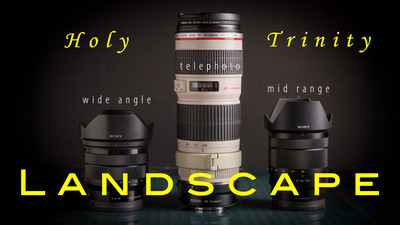
 Hey Everybody! Hope You're having a great week! I'm getting ready for a Fall Colors Trip with my photography club and it will be mostly landscape photography. So I'm excited to go! I have been going on these workshops for over a decade and always come back with some great shots. This week I want to talk about the different types of lenses for landscape photography and the advantages and dis-advantages of the different lens focal lengths. I Really won't be talking about hardware too much but of focal length ranges and what type of shot each type of lens is good for. This blog will be talking about zoom lenses only, as I
 think that they are the only type of lens you need for Landscape work. They are versatile and convenient to use because you can't always zoom with your feet like you have to do with Prime lenses. In this discussion I won't be grouping Astro photography into the Landscape realm although many consider Astro as Landscape. I believe it is too a specialized section of photography to be jumbled in with Landscape. The Holy Trinity of lenses are commonly referred as a 16-35 wide angle zoom, 24-70mm midrange zoom and a 70-200 + telephoto zoom. All of these are full frame equivalent so if you shoot a crop sensor it's 10-18mm 18-50mm and 50-150+mm . I will go over them in the order of importance I think they should go in order of acquiring if you don't have the lenses, I'll explain...
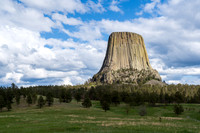
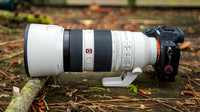 Telephoto range, 70-200+mm zooms. What I like about using a telephoto zoom is you can use it in almost any condition. What I mean is if you have blue sunny skies although good for a baseball game not so good for landscape photography. With the telephoto zoom you can cut out the sky altogether and isolate a certain subject . A rock , A tree

something that a wide angle or a midrange zoom has trouble with. It has a narrow field of view which translates into not as busy of a scene. You can take the viewer right to what you want them to see. It brings distant objects closer. Say a mountain or a tree. From far away you can feature the object as the subject. Something you can't really do with a wide or midrange zoom. It can make your shots more simple and in photography a simple photograph talks volumes more than a complicated one. I would recommend this type of lens to a new landscape photographer before I would a wide angle lens because you don't have to work as hard to get stunning photographs.
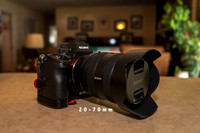 Midrange, 24-70mm zoom. This lens has an expanded field of view compared to the telephoto and is great for woodland shots. Intimate forest scenes are great with this lens. It has more of a range of what the human eye can see. It is the Swiss Army knives of lenses and is very useful. I just did a Lightroom search for what focal length I use most and by far this range was the most used. A mid range zoom is on my camera most of the time and is usually where I start. Some people call this range the boring range because the super wide angle or the telephoto zooms tend to be more dramatic. It
 does have enough zoom factor to zoom in a little making a scene less complicated. It can be very wider than the telephoto so skies and distracting parts of your frame can be more amplified and harder to control. If you're a new photographer you probably got some sort of kit lens in this range. But all that said I do like this range and it fits my eye very well.
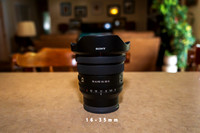 Wide angle range, 16-35mm zoom. These lenses have the widest field of view and bring the whole scene in. If you have a sweeping vista this is the lens. This lens is the hardest to compose with because it brings so much of the environment in. Usually you have to find some sort of foreground element into the shot and get very close to it . Like a rock , bush or stump. This lens tends to distort the distance of things also. Mountains in the background seem to shrink
 in size and things in the foreground are larger than life. This type of lens is very condition dependent and if the skies aren't nice leave this one in the bag or get so close to the subject that you can't see the sky. These lenses can create a very busy and complex scene because it brings so much of the scene in. For me this would be the last lens I would put into your arsenal as it is the hardest to use for good compositions.
My current Landscape lenses are the 16-35mm, 20-70mm and either a 100-400 or a 70-300 which is much lighter to carry than the 100-400 if I have to hike a distance or so. Notice I didn't mention maximum aperture of the lenses. You could get the wide angle and midrange zoom of these lenses at f/2.8 maximum aperture but it would cost twice as much and be twice as heavy. For me a constant f/4 lens is plenty. I usually shoot between f/8 and f/11 and if the light is real low I will have my camera on a tripod so the f/2.8 for weight and price is a disadvantage.This is the 3 lens focal lengths that are the Holy Trinity but some landscape photographers cut out the midrange zoom and just shoot with wide angle and telephoto zooms for all of their photography. For the upcoming trip I'm going to try to use my 16-35mm more and the 20-70 less for an experiment to see how my photographs turn out. Well that's it for this week until next week ... Get out and Shoot!
Hey if you want to check out my photography go to my instagram account Max Stansell Photography there are over 2000 posts there. Here is the link
Max Stansell Photography Instagram Link
