Does Gear Really Make the Photo II, Post trip conclusions
The quality of my little mirrorless camera didn't surprise me. It is a fantastic camera with a great sensor. As you probably know, I have been using a Sony crop sensor mirrorless for the last couple of years. I first bought one to use hiking and slowly fell in love with it. I upgraded from a Sony A6000 to a A6300 this year, and it is a great camera. A mirrorless crop sensor has been my main camera for a couple of years now, and I think I'm going to take the plunge and get rid of all of my Big Boy camera and lenses and go to a mirrorless crop sensor from now on. I have already sold a couple of lenses and plan to sell my full frame bodies and other lenses and flashes that I have. I'm going to gear down instead of gearing up like I usually do. The quality of my photos was the same or even better in my opinion. Below are some photos that I have taken from two years ago and from this trip. I put them side by side so you could see if there was a big difference in quality of the photos. Take time to look at them and see if you can tell which one was a full frame camera with F2.8 glass and which one was my little mirrorless Sony with F4 glass. The photos on the left side column were taken with a full frame Nikon D800 with F2.8 lenses. The photos on the right were taken with a mirrorless crop sensor Sony A6300 with F4 lenses. To me it is hard to tell the difference, especially if they are going to be used on the internet or to make prints or canvases that I would print. Are the full frame cameras great? You bet they are they are fantastic! The professional 2.8 glass is awesome! But do I really need it for the type of photography that I'm going to do? I don't think so. The mere size and weight of theses cameras are what is really turning me, and the quality of the shots that I'm getting with this small camera is some of the best I've shot. If I were doing a lot of portraiture or weddings, the larger camera would be an asset. But for what I do, it is not. So now I am taking inventory and getting rid of all of my larger gear. Will I ever buy a full frame camera again? Probably, but it will be of the mirrorless cameras that are full frame which makes them smaller. But for now I'm going to stick with the camera that I used this year. Any thoughts? Let me know and keep shooting!
Product Review Neewer N40S
My first impression of it when I got it was that it was small. It feels well built and comes with a case that is well built. The guide number is 40, and the guide number of my Yongnuos are 58. So they are not quite as strong as the Yongnuos are. But thats okay. I'm not looking to do a lot of flash photography with my Sony. Very easy to operate with dial and not a digital display with complicated menus. The unit can be run in manual, automatic , TTL, and high-speed sync, and it has a video light built in. Now, the video light is not its strongest feature, but it's kind of cool that it has one.
Here are two photos that were both taken at 1/2000 sec @ f4.0, the one on the left without flash and one on the right with flash. High speed sync check! This little flash has ticked all the boxes on my checklist. I think for the money and what I'm going to use it for, it's the right one for me. Keep shooting! Does Gear Really Make the Photo?They say that admitting to a problem is the first step in solving a problem, so here goes. I have been a gear hound for a long time. I have GAS (Gear Acquisition Syndrome). For some time now I have been under the impression that gear makes the photo, and I'm not alone. There are lots of you just like me. I have accumulated some of the finest gear that money can buy, and my photos have improved. But was it because of my gear or the know how that I have acquired learning how to use this gear?
My camera club goes to the mountains once a year and spends a week with the fall colors, waterfalls, and wildlife. This week is the most photo active time of the year for me as I am not a professional full-time photographer. Some of my best photos of the year come from this trip. I usually carry my big camera and all of my expensive lenses with me and really get good results. A couple of years or so ago I purchased a Sony mirrorless camera that has become my go-to camera. It's small and compact compared to my big Nikon rig that I have. I bought it for backpacking because of its size and weight, but I have come to love it. So this year when my camera club goes to the mountains, the Sony mirrorless camera will be my main camera for the trip. I will use it for the waterfalls, wildlife, all the fall colors, and everything else. I will take my Nikon and one lens as a backup. The Sony kit will contain the following items:
My Nikon will be the D800 with 24-70mm 2.8 lens.
How many times have you been looking at Facebook or some other social media outlet and saw a fantastic photograph, only to be dismayed when you found out it was taken with an iPhone? Remember, photography is supposed to be fun and not a contest to see who has the most or the biggest gear. Enjoy your photography, and save your money so you can go to more places to use your photography. Remember, it's not the camera. It's the photographer that takes great photos. I plan on gearing down and making things more simple, not more complicated. Get out and shoot!
William B. Umstead State Park Hike
Hiking Gear
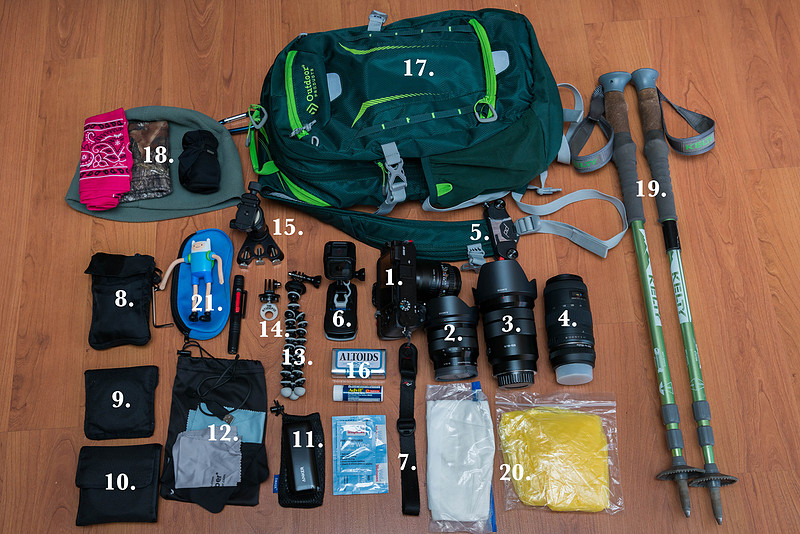
As a landscape and nature photographer, hiking is kind of second nature. You have to get to great locations to get great shots that everyone else does not have. The longer your hike is, the more important it is to pack light. Weight matters! My everyday/hiking kit I try to keep as light as possible. The kit I'm going to show you is right at 7 lbs. My big professional Nikon D800 camera and one lens weigh in at 5 lbs. That's only one lens, no tripod filters or anything else, just camera. My hiking kit consists of four lenses (I have other ones in the wings to switch out if I need to), a tripod, filters, and lots of other goodies. Here is a photo of my stuff and an itemized list.
1. Camera Sony A6000 (crop sensor) with Pentax 28mm f2.8 vintage lens which I used on a film camera about 30ish years ago. With the crop sensor, the lens is at a focal length of about 42mm, good for close photographs like a walk in the woods. 2.Wide angle lens Sony 10-18mm f4. Gives me a focal length of 15-25mm with the crop sensor. Super sharp lens for big landscapes like the mountains. 3. Mid Range Telephoto- 18-105mm. This one gives me a focal range of 25-150mm. This is the lens that gets swapped out a lot with other lenses. This is a great all-in-one lens and has given me some great photos. Depending on where I'm hiking, this may or may not be in the bag as it is sometimes swapped out for a vintage 35-70mm f2.8 lens. 4. Telephoto Pentax 80-200 mm f4.6. Gives me a focal range of 120-300mm. This is a cheap plastic lens that I got 30 years ago, but it's lightweight and pretty sharp. This is the range that I use the least. 5. Peak Design clip. This allows me to put my camera right on my backpack strap to keep my hands free but gives me quick access to my camera. 6. GoPro Session 4 on a hat clip. The GoPro is the newest addition to my camera kit. I used to use my phone for everything video-wise, but this is a great piece of kit! I can use it for biking also and it's waterproof. 7. Peak Design Leash. Love this for this small camera. It gives me a sense of security when it's strapped to my wrist! 8. Batteries and Charger. Mirrorless cameras can eat up batteries, so I carry two extras and odds and ends in this case. 9. Polarizer Case. I carry circular polarizers for most of my lenses. 10. ND Filters. I carry a variable circular natural density filter and step-down rings to fit most of my lenses. 11. Anker 10500 mAh. I use this to charge GoPro, camera batteries, and iPhone. 12. Bag for GoPro and cleaning clothes for lenses. 13. Joby Gorilla Pod for GoPro. 14. Stick Pick Mount. Allows me to put GoPro on my hiking stick like a selfie stick. 15. Trail Pix Ultra light Tripod. I'm able to use this with my hiking sticks with one from a buddy and create a tripod that will handle up to 7 lbs. 16. Altoids, Advil, Tums, moist lens clothes for my glasses and or lenses. 17. Outdoor Products Hydration Pack. I got this from Walmart for 40 bucks, and it works great for this small load. 18. Fleece skull cap, neck warmer, waterproof gloves, and bandana for keeping warm and such. 19. Kelty Trekking Poles. This is probably one of the best kept secrets in hiking. Trekking poles will save your knees and save your butt from falls. They are great long trips. 20. Emergency poncho, wet wipes. Poncho is for rain showers. I got caught in the rain once on a hike and just got drenched, and since then I always carry an emergency poncho. And for those emergency bathroom breaks without a bathroom, the wet wipes or toilet paper is a must. 21. Finn the Explorer, sunglass case, lens brush. Finn the Explorer is new, and he travels with me. I try to take a photo of him when we go to a new place. Sunglass case and lens brush are self explanatory. |